
Why searching before launch could save your brand in Australia and New Zealand
If you are a brand owner looking to enter the Australasian market (or are advising brand owners entering the market), the recent Australian High Court decision of Zip Co Limited v Firstmac Limited [2026] HCA 16 is worth your attention.
While the High Court did not make pre-launch trade mark clearance searching in Australia mandatory, it did make it clear that brand owners choosing to use a mark without one may lose out on claims of honest concurrent use later.
What is “honest concurrent use”?
Australian trade mark law recognises that two businesses can sometimes end up using similar brands without one deliberately setting out to copy the other.
In the right circumstances, the later user may still be able to register its mark, or even defend an infringement claim, despite the earlier trade mark rights. Without the defence, the later user may end up in a situation where they face infringement action and/or are forced to rebrand entirely.
The key to getting the “right circumstances” is honesty, and the decision of Zip Co is the first time the Australian High Court has fully considered what honesty really means, and explains why clearance searching should form part of your pre-launch strategy.
The Background
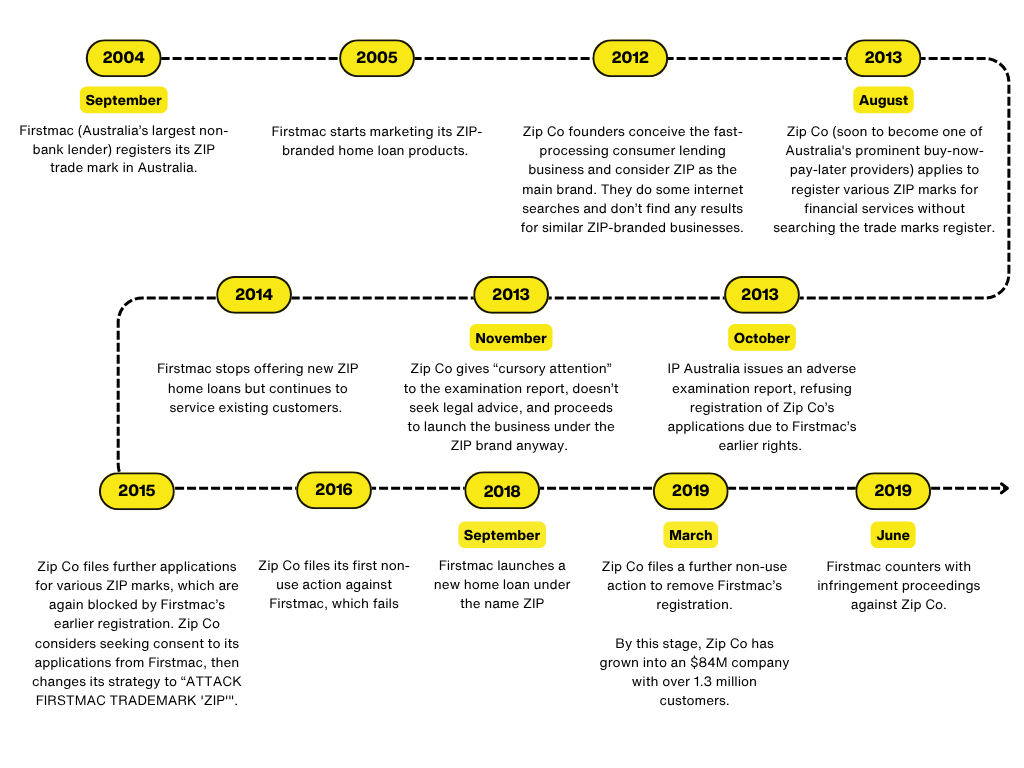
Click here to expand the full timeline.
What the Australian High Court found
What the business actually knew matters
Honesty is assessed according to what the business actually knew at the relevant time (i.e. when it first used the mark or sought registration), but that state of mind is assessed against the standards of “ordinary, decent people”.
The business trying to rely on honest concurrent use has the burden of proving its honesty.
Carelessness alone isn’t dishonesty
Mere negligence won’t automatically defeat a claim of honest concurrent use, but if an applicant knew about a conflicting mark, suspected there may be a problem, or deliberately avoided investigating, and then proceeded without engaging with the issue, it may be difficult to establish honesty.
The practical effect of Zip Co at IP Australia
Following the decision, IP Australia moved quickly to update its Trade Marks Manual, specifying that evidence of honest adoption and use of a trade mark should form part of an honest concurrent use claim, and setting out a “non-exhaustive list of circumstances relevant to establishing honest adoption”, including:
- What checks did you make before launching?
- If you did not do any checks beforehand, why not? Would someone in your position be reasonably expected to do more?
- Did you know about the earlier mark?
- If you knew about the earlier mark, why did you choose to proceed anyway?
The Manual’s emphasis on the applicant’s knowledge and circumstances suggests that different considerations may arise where an established overseas brand is being extended into Australia, or into a new field of goods or services — for example, a brand owner with no prior presence in the Australian market may have a more sympathetic explanation for not searching the Australian register than one already operating here.
The practical lesson
For practitioners advising on brand adoption in Australia, the Zip Co decision crystallises the importance of adding pre-adoption clearance searching to the brand strategy checklist.
If a business proceeds to use a mark in Australia without searching, or identifies a conflict but presses ahead anyway, establishing honest concurrent use in your trade mark prosecution strategy (or infringement defence) may be difficult.
What about New Zealand?
The Zip Co decision isn’t binding in New Zealand, but the reasoning could still be influential here.
New Zealand also recognises honest concurrent use as a basis for registering a trade mark under section 26(b) of the Trade Marks Act 2002, and the Intellectual Property Office of New Zealand applies the same factors for determining honest concurrent use as Australia does, including an assessment of the honesty of use.
Those factors were considered in the recent New Zealand High Court decision of Brands Ltd v Bed Bath ‘N’ Table Pty Ltd [2023] NZHC 1766. Bed Bath ‘N’ Table was able to establish honest concurrent use despite having earlier knowledge of the competing BED BATH & BEYOND brand, but the decision clearly highlighted that the reasons for adopting the mark and surrounding commercial circumstances mattered to that assessment:
- Bed Bath ‘N’ Table was a pre-existing brand with independent goodwill, having been used in Australia for over 30 years before entering New Zealand.
- There was no intention to deceive and in fact both businesses bore the confusion risk equally.
- Bed Bath & Beyond knew in advance of Bed Bath ‘N’ Table’s intended entry into NZ and didn’t object for eleven years.
- By the time Bed Bath ‘N’ Table applied to register its mark, it had been operating nine stores concurrently in New Zealand for seven years without complaint.
- There was some market differentiation between the two businesses, which reduced the anticipated risk of confusion.
- There was a disclaimer on Bed Bath & Beyond’s registration that use of the non-distinctive words “Bed” and “Bath” was not restricted, so Bed Bath ‘N’ Table could reasonably have believed it would not infringe it by using those common descriptive words.
Contrasting this with Zip Co, while both businesses were aware of competing marks, Bed Bath ‘N’ Table could explain why it had proceeded: it had a pre-existing brand, a genuine commercial reason to use it, and a reasonable basis for believing confusion was unlikely. Zip Co’s founders, by contrast, became aware of a conflicting right and pressed ahead without engaging with it or explaining why they believed use was legitimate.
Key takeaway for businesses looking to operate in Australasia
Before launching in Australasia, brand owners should ideally be:
- Searching both the market and trade marks registers appropriately.
- Investigating conflicts.
- Documenting what was known, what advice was received, and why the business decided to proceed.
If you need help conducting clearance searches in Australia or New Zealand, our specialist Intellectual Property team can assist. Contact us to discuss.
Special thanks to Partner Katy Rostovitch for preparing this article.
Disclaimer: The content of this article is general in nature and not intended as a substitute for specific professional advice on any matter and should not be relied upon for that purpose.